As you walk, or drive, through the Village today it’s not always easy to remember that a hundred years ago Spencers Wood was still primarily an agricultural community. It’s true a growing number of residents commuted to Reading to work – maybe in Huntley and Palmers, Suttons Seeds or Symonds Brewery, the “three Bs” for which Reading was famous – but most residents still worked in agriculture or the local services that supported them. This is not to say that nothing had changed – the growth of Reading and improved transport links to London had resulted in new markets for market gardening and fruit growing and dairying. The evidence for this can still be seen in the street names like Apple Tree Lane and Orchard Close. It was an enquiry from a correspondent in Hampshire which drew our attention to another development, the growth of chicken farming, commemorated in the road name Pursers Gardens.
Our correspondent was researching the history of a country house known as “Pursers”, in the parish of West Meon in Hampshire when he discovered links with Pursers Pedigree Poultry Farm in Spencers Wood. Initially registered in Hampshire in the early 1920s, the registered address for the Farm later changed to Spencers Wood. One name associated with both properties was that of D. W. Gunston, M.P. and our correspondent wondered whether we could provide any information about either.
Barry, one of our members, set out to find out more…
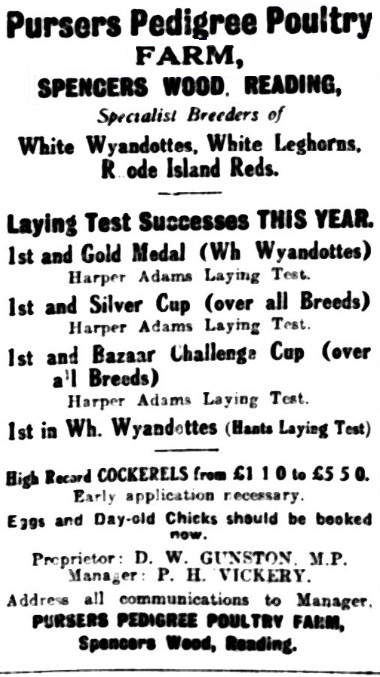
The property was not known as Pursers Farm until 1924. Previously it would appear to have been known as Hill House Farm. In 1924 Hill House Farm was put up for sale. At that time it was already a poultry farm and it was apparently bought by Sir Derrick Wellesley Gunston, who had been farming poultry at Pursers in Hampshire. He bought with him Percy Vickery, who according to the electoral roll had been living at Pursers Lodge, West Meon between 1923 and 1925 as his farm manager, together with Vickery’s wife Florence.
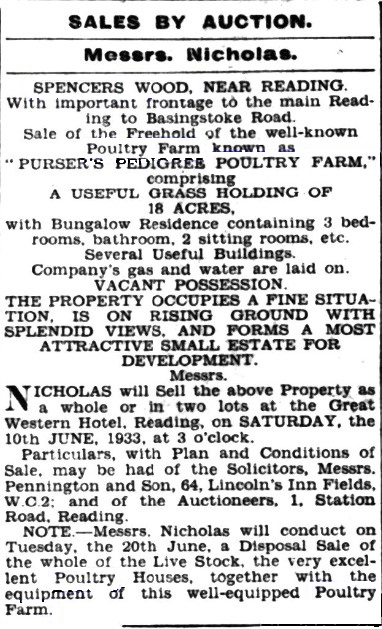
There is a surviving newspaper advert dating to 1925 which suggests that they were successful in breeding prize-winning chickens but by 1933 the Farm was again advertised for sale by auction by Nicholas Estate Agents.
Sir Derrick served in the Irish Guards in World War I and was awarded the Military Cross in 1918. 1n 1924 – the year in which he apparently purchased Hill House Farm – he was elected as MP for Thornbury in Gloucestershire and held the seat until 1945 when he was defeated in the Labour landslide of that year. In 1938 he was created Baronet of Wickwar, also in Gloucestershire. As far as we’ve been able to establish, Percy Vickery and his wife continued to work as poultry farmers and in 1939 are recorded as farming at Kings Farm in Harpsden near Henley with their son, John Henry William Vickery. After the end of World War II they moved to Caversham and Percy died at Battle Hospital in 1961 when his address was given as Wheelers Farm, Swallowfield.