Chicken Farming…

posted in: Farms and farming | 0

As you walk, or drive, through the Village today it’s not always easy to remember that a hundred years ago Spencers Wood was still primarily an agricultural community.  It’s true a growing number of residents commuted to Reading to work – maybe in Huntley and Palmers, Suttons Seeds or Symonds Brewery, the “three Bs” for which Reading was famous – but most residents still worked in agriculture or the local services that supported them.  This is not to say that nothing had changed – the growth of Reading and improved transport links to London had resulted in new markets for market gardening and fruit growing and dairying.  The evidence for this can still be seen in the street names like Apple Tree Lane and Orchard Close.  It was an enquiry from a correspondent in Hampshire which drew our attention to another development, the growth of chicken farming, commemorated in the road name Pursers Gardens.

Our correspondent was researching the history of a country house known as “Pursers”, in the parish of West Meon in Hampshire when he discovered links with Pursers Pedigree Poultry Farm in Spencers Wood. Initially registered in Hampshire in the early 1920s, the registered address for the Farm later changed to Spencers Wood. One name associated with both properties was that of D. W. Gunston, M.P. and our correspondent wondered whether we could provide any information about either.

Barry, one of our members, set out to find out more…

The property was not known as Pursers Farm until 1924. Previously it would appear to have been known as Hill House Farm. In 1924 Hill House Farm was put up for sale. At that time it was already a poultry farm and it was apparently bought by Sir Derrick Wellesley Gunston, who had been farming poultry at Pursers in Hampshire.  He bought with him Percy Vickery, who according to the electoral roll had been living at Pursers Lodge, West Meon between 1923 and 1925 as his farm manager, together with Vickery’s wife Florence.

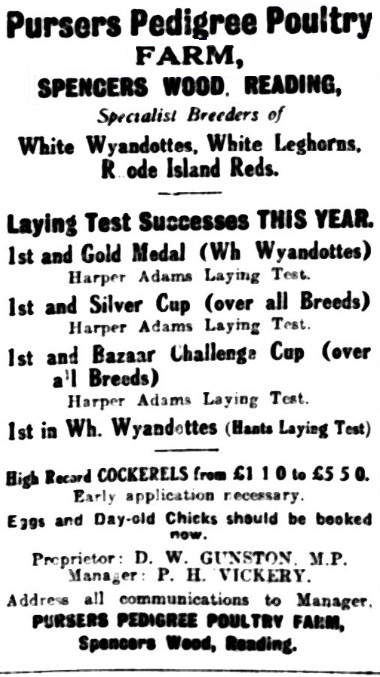
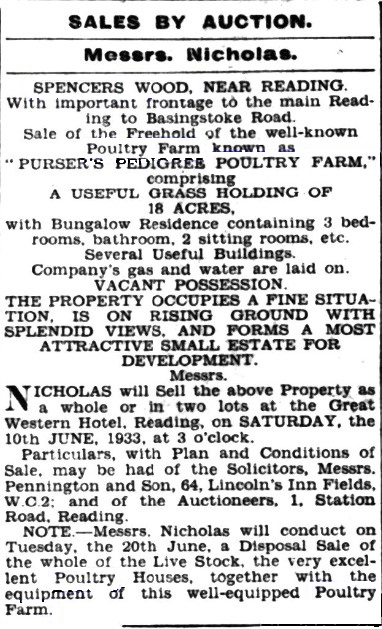
There is a surviving newspaper advert dating to 1925 which suggests that they were successful in breeding prize-winning chickens but by 1933 the Farm was again advertised for sale by auction by Nicholas Estate Agents.

Sir Derrick served in the Irish Guards in World War I and was awarded the Military Cross in 1918. 1n 1924 – the year in which he apparently purchased Hill House Farm –  he was elected as MP for Thornbury in Gloucestershire and held the seat until 1945 when he was defeated in the Labour landslide of that year.  In 1938 he was created Baronet of Wickwar, also in Gloucestershire.  As far as we’ve been able to establish, Percy Vickery and his wife continued to work as poultry farmers and in 1939 are recorded as farming at Kings Farm in Harpsden near Henley with their son, John Henry William Vickery.  After the end of World War II they moved to Caversham and Percy died at Battle Hospital in 1961 when his address was given as Wheelers Farm, Swallowfield.
Farewell

Two long established members of our Group are leaving the Village. Margaret Bampton was one of our founding members back in 1995 and has been a mainstay of the Group and one of the principal contributors to our books and the website over the years. Mary Wheway joined the Group a little later, in 2004. She was formerly a teacher at Ridgeway Primary for 30 years and in her retirement she proved to be just the person needed to lead the editing and publication of all three of our most recent books.

Their departure has resulted in our having to find new homes for the many photographs and other items that have been stored in their respective homes. Amongst these was a collection of photographs taken by Chris Bukin, then aged 8, for a competition organised by Lambs Lane School in 1972, two of which are reproduced here.  The full collection can be found in the Resources section of the website.

Margaret and Mary will both be much missed and we wish them all the best for the future.

Photos by Chris Bukin

Elisha Close

This is the first post – there’ll be another to follow – about the Elisha family in our series about people commemorated in local road names. For those that haven’t come across Elisha Close before, it’s off Beech Hill Road on your right as you leave Spencers Wood…

The Elisha family were builders, farmers and farm workers who have lived in Shinfield parish since at least 1602, when a William Elisha married Elizabeth Pither in St. Mary’s church, Shinfield on 10th October. This post looks at two generations of the family, both named John Elisha, and the wife of the second John Elisha, Dorothy Davis, who lived at the turn of the eighteenth and nineteenth centuries.

The first John Elisha and his brother, James were both successful builders and bricklayers, each owning their own brickworks, and were followed into the business by their sons. John Elisha’s life spanned pretty much the entire eighteenth century, from his birth in 1707 to his death in 1787. In his will, made in the last months of his life, he describes himself as a Bricklayer, living in Swallowfield. From as early as 1768 we can see from the Poll Book that although he lived in Swallowfield, he owned property in Shinfield and thus had the right to vote – then restricted to property owners. At this time Ballots were not secret and how people voted was recorded and published in poll books. In this case, like most voters, John Elisha voted for the sitting MPs, Thomas Craven and Arthur Vansittart. The third contestant, John Stone of Goldwell, was considered a weak candididate nevertheless Vansittart is said to have spent £5,000, about £440,000 today, on securing his re-election.

We can see from his will that when he died in 1787 John Elisha had continued to live in Swallowfield but by then had property in Shinfield, Three Mile Cross and Farley Hill, including owning the Blacksmith’s shop in Shinfield. His estate was divided between his son, John Elisha and his daughter, Elizabeth and her husband William Collins. From his father’s will we know that John Elisha the younger was living in Three Mile Cross at this time. In his own will, made a decade later in 1796, he too describes himself as a bricklayer however, apart from a reference to “stock in trade” which might or might not relate to the building trade, his will is focused almost entirely on farming.

John the younger left everthing to his wife Dorothy for the rest of her life, providing she did not re-marry, with detailed instructions on how the farm was to be managed which give an insight into farming at the end of the eighteenth century. His son Richard, who had been working alongside his father, was to act as baliff and run the farm for his mother, buying and selling “and out of the profitts thereof keep up a sufficient stock of cattle and implements to manure, plough, sow and gather in the corn and grain growing thereon and to inbarn, house, rick, thresh out and carry the same to market and also to act and do everything to the best of his knowledge in [a] reasonable way to preserve and keep the Farm in an husbandlike state and manner”.

From the records of the Land Tax for 1798 we can see that Dorothy owned freehold property and land, including houses in Millworth Lane, Shinfield and Whitley Wood and held even more land as a tenant farmer, possibly including Hartley [Court] Farm. This was a profitable time to be a farmer, with increased yields due to the Agricultural Revolution and high prices as a result of shortages due to the Napoleonic wars. From John Elisha’s will we can see that the Elishas were mixed farmers raising horses and cattle and growing corn and hay. The corn and surplus cattle were sold while the straw from the corn and the hay were used for feed and bedding for the remaining cattle and horses.

When Dorothy died in 1806 it appears that the farm was sold up. Richard and his youngest brother, George appear to have moved to Shoreditch in London where they followed their father and grandfather as bricklayers. Their brother Thomas also became a bricklayer and is recorded in the 1841 census living in Earley with his son George, also a bricklayer. Only their oldest brother, another John Elisha, continued farming in Spencers Wood – more about him in a future blog.

Pither Close

This week’s Blog is about the Pither family recalled in the road name Pither Close, off Fulbrook Avenue in Spencers Wood. The family was widespread throughout the district, first appearing in documents from the fifteenth century. In our book, More from Our Village of Spencers Wood, there’s an account of Thomas Pither who was the tenant farmer of Highlands when it was sold in 1797.

Whether Thomas Pither was related to Ann, the widow of James Pither who died in 1837, is not certain but it seems possible that he was Ann’s father-in-law. It is however possible to piece together the story of this family of women farmers from their wills and the census records. In the 1841 census Ann, a widow aged 70, is recorded as being a farmer in Shinfield (probably in Spencers Wood), living with her children, Thomas (47), Lydia (35), Hannah (28) and Maria (25). Her oldest daughter, Jane or Jenny, Pither, aged 40 at the time, is also recorded as being a farmer in Shinfield, living with her sister Sarah (30) and two nieces, Margaret Deane, aged 9 and Sarah Deane, aged 7 as well as William Holder, an Agricultural Labourer, aged 25, and two farm boys, Benjamin Long (16) and Richard House (15).

Ann Pither died in 1846. What became of Thomas Pither is uncertain but in the 1851 census the farm is being run by Lydia, now recorded as aged 50, farming 50 acres, employing four labourers and living with her sisters Sarah and Hannah and their older niece, Margaret Deane. By 1861 the farm, now reduced to 38 acres and employing two men and a boy, is being run by Sarah, who is living with her sister Hannah, Margaret Deane and also a ploughboy, George Monger, aged 13, presumably the “boy”

mentioned above. (During the nineteenth century it was still common for younger farm workers to “live in”, only moving out when they married and set up a home of their own, often still “tied” to the farm where they worked). Meanwhile Jenny Pither continued to occupy the other farm, described as being 87 acres and employing three men and two boys. We know the names of two of the men, William Holder, now farm bailiff, and Caleb Cox, a carter, as well as George Fulker, aged 14, a carter’s boy and also Jenny’s other niece, Sarah.

Whether the two farms were actually run independently of each other is open to question. In his will, James Pither left his whole estate to his widow, Ann and in her will Ann left her estate to all four daughters as tenants in common. This could mean that the daughters held different size shares in the farms and that Jenny did hold the largest share. What we do know from the wills is

Left: Wilders Grove Farmhouse, Ryeish Lane as it is today

that although the family owned the freehold of some of the land, some of the land was held as copyhold, a form of protected tenancy, and other land was rented.

By 1871 there has been some consolidation and the farm, which we now discover from the census was Wilders Grove Farm in Ryeish Lane, is described as being 50 acres and employing two men and a boy, and as being run by Jenny. Living with her are her two sisters, Hannah and Sarah, nieces Margaret and Sarah, as well as William Holder, the farm steward, and a boy, James Miles, aged 15. Over the next ten years all three sisters died, Sarah in 1871, Jenny in 1877 and Hannah in 1878. The 1881 census records their two cousins, Margaret and Sarah Deane as living together in retirement in Ryeish Green with a boarder, retired farm bailiff, William Holder. Sarah died in 1885 and Margaret in 1889. This marked the end of this line of the Pither family (although there were others living in Shinfield parish and in nearby villages). William Holder outlived them all. In the 1901 census he is recorded as living with his niece, Mary Holder in Hyde End Road. He died in 1907 living to the ripe old age of 93.

Right: Although this branch of the Pither family died out as the poster reproduced here other branches of the family continued to live in nthe district.

FLOYERS GROVE

This is the second in our occasional posts exploring the stories behind local road names. Last week we introduced you to the Earl of Fingal and his estate map and Appleby family, commemorated in Fingal Crescent and Appleby Walk. This week we’re focusing on just one road name, Floyer Grove, off Beke Avenue behind the Health Centre in Shinfield.

Left: The former Floyer’s Barn on Hyde End Road, all that remains of Floyers Farm – now undergoing further redevelopment

Peter Floyer and his family lived and farmed in Spencers Wood in the early part of the eighteenth century. On Fingal’s Estate Map of 1756, Floyers Land is marked as an area on Hyde End Road between the Basingstoke Road and Grovelands Road. All that remains now is the barn, an unremarkable building that’s easily missed, which until recently was known as Floyers Barn. Colonel Peter Floyer had served under the Duke of Marlborough in the French wars, known as the War of the Spanish Succession 1701-1714, and on his retirement had settled in Shinfield. Father and son, also named Peter, were original trustees of the Infant School on School Green, established in 1707. On the north wall of St. Mary’s Parish Church there is a tablet to Mary Floyer, his wife, dated 1726.

In an extract from the farms of Shinfield, Floyers Farm is described as being 45 acres 3 rods 28 perches (approximately 18.3 hectares) in size. In 1765 the “Annual Register” records “In the garden of Peter Floyer of Shinfield there are some rasberry trees in perfect leaf and so well stocked with ripe fruit that they have been gathering from them every day this month past. They are likewise in the same garden very fine full-blown jassmines, pinks, honeysuckles and a very fine carnation near blowing.”

Less is known about the later history of the farm. In 1862 it was a small, unnamed farm between Ryeish Green and Spencers Wood owned by Rev. George Hulme. In 1871 we know the farm was occupied by Mr John Thorpe and on 13 May 1879 it was sold in auction by Charles Simmons on behalf of Rev. Bernard Richard Body, a member of the Body family which lived in Shinfield for many years and owned several properties in the area.

The Naming of Names

Ever wondered about your street name?  Who was Elizabeth Rout commemorated in the name Elizabeth Rout Close? What has Fullbrook Avenue to do with overflowing streams? The answer is very little. And Marlow Place has next to nothing to do with the town on the banks of the River Thames…

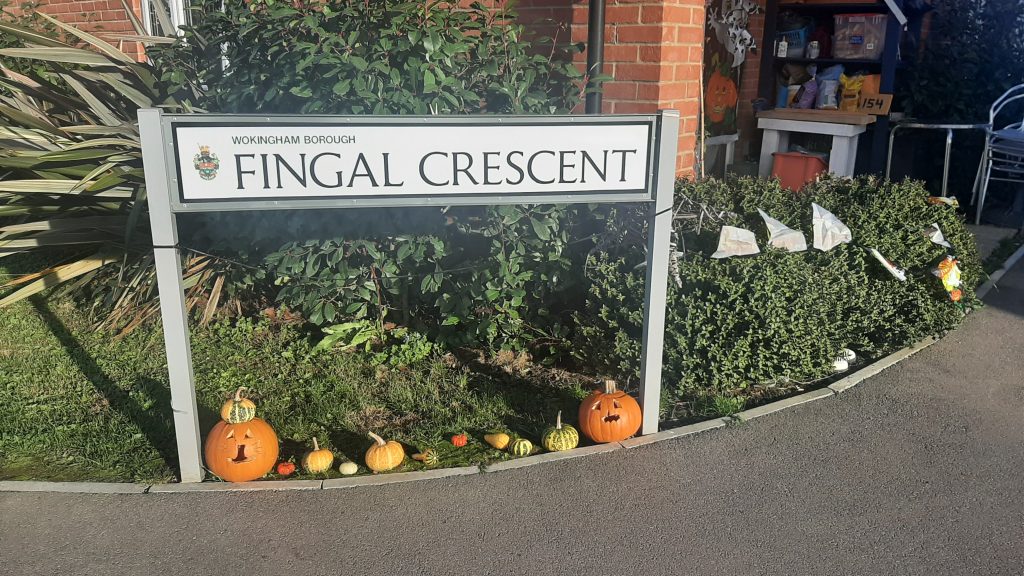
This is the first in a series of blogs in which we will explore the history behind our local road names, especially those associated with the new developments in Spencers Wood,  Shinfield and Three Mile Cross. Today we are starting Appleby Walk, which you will find on your left as you walk down Fullbrook Avenue from Hyde End Road in Spencers Wood towards Ryeish Lane and the bus link to Shinfield, and Fingal Crescent, which you’ll find on your right a little further down Fullbrook Avenue just after it crosses Croft Road.

The Earl of Fingal was the major local landowner in the eighteenth century. In 1755 he had married Harriet Woolascot, the heiress of William Woolascot of Woolhampton. The Woolasots had been lords of the manor in Shinfield since 1623 when William Woolascot married an ealier heiress, Anna Martyn. On becoming lord of the manor, Fingal commissioned a survey of his new estates and the resulting map is the main source of our knowledge about the tenants who were farming his land at that time.

The Appleby family were one of his tenants and held most of the land that has recently been under development. In 1611 the land was part of Blackhouse Farm and was mentioned in Nicholas Russell’s Will of that year and was part of a Charity set up to pay 20 shillings a year (a pound for younger readers) to the poor of Shinfield village. Mrs Abbleby was named as the tenant on the Earl of Fingal’s estate map. She was descended from a Reading tailor named John Appleby, who was born in about 1620. The land was left to her relation the Revd. John Appleby on her death in 1787. The Revd’s wife Grace died in 1820 and he died in Nov 1825 in Easthorpe, Essex. Later maps show that the land was then left in the hands of trustees and remained in ‘Chancery’ until 1866 when the land was sold.

The Appleby family were one of his tenants and held most of the land that has recently been under development. In 1611 the land was part of Blackhouse Farm and was mentioned in Nicholas Russell’s Will of that year and was part of a Charity set up to pay 20 shillings a year (£1.00 for younger readers) to the poor of Shinfield village. Mrs Abbleby was named as the tenant on the Earl of Fingal’s estate map. She was descended from a Reading tailor named John Appleby, who was born in about 1620. The land was left to her relation the Revd. John Appleby

on her death in 1787. The Revd’s wife Grace died in 1820 and he died in November 1825 in Easthorpe, Essex. Later maps show that the land was then left in the hands of trustees and remained in ‘Chancery’ until 1866 when the land was sold.