Although Shinfield’s VE Day Commemorations had to be cancelled due to the current restrictions we’ve taken the opportunity to update our website to create an area about the impact of the Second World War, and the Great War, on the Village and its residents. This includes information from previous posts including accounts of evacuees and the impact of the wars on our village schools as well as new information.
The former United Reform Chapel, Basingstoke Road
We’ve also created a new Resources area on the website which will contain free downloadable files and information. With so many people taking advantage of the current restrictions to explore the area by bike or on foot, the first item to be uploaded is a history-focused walk along the Basingstoke Road.
Some people may feel that somewhere like this doesn’t have much of a history to speak of but we would beg to differ. All along the Basingstoke Road from Three Mile Cross to Swallowfield there are hints and clues to be found which add interest to an afternoon’s walk, for instance the old orchards that used to grow where Apple Tree Lane now stands, a reminder of the village’s former history of market gardening. No need to walk the whole distance in one go but if you’re feeling energetic…
As we celebrate 100 years of Women’s right to vote in the UK, our group wanted to show what impact this had on the local community, and how many women’s lives this fundamentally changed.
The campaign for women had begun in 1866, when a petition was handed in to Parliament by John Stuart Mill M.P. The petition, with 1,499 signatures was received with ridicule. 52 years later, on 6 February 1918, the Representation of People Act gave the vote to all men over 21, and all women over 30 (falling into certain categories) the vote.
Two of our members went to the Berkshire Records Office to investigate the electoral roll for the area. In 1918, Spencers Wood was in the Swallowfield Polling District, which fell in the Newbury Parliamentary Division.
In the electoral role, each person who was eligible to vote is listed and categorised for their “eligibility” to vote. Their residency isn’t shown (like now) merely a house name, or street, and the area – e.g. Spencers Wood, Riseley, Three Mile Cross etc. The qualifications on the electoral role are listed as:-
Evidence based
Business premises qualification
Occupation qualification
Qualification through husbands occupation
Naval or military career
Women could only vote via one of four categories:-
If they were home owners;
If they were wives of home owners, or
Occupiers of property with an annual rent of £5 or more, or
Graduates of British universities or similarly qualified.
One criteria had to be met, and that they must be over 30 years of age. There were three listings of electoral rolls – presumably for the categories a) to c). As a percentage we found that Spencers Wood had 81 women who gained the vote, a percentage of 13.68% of the total electorate. Of that, 63 were because they were married to a home owner (77%) & 17 because they were a home owner themselves (21%). Only 1 was on the last register – an occupier of substantial of land in Beech Hill. Whilst the category of home owners themselves, we thought was particularly high, this is offset with the time & the country just concluding the Great War. Many of the men in the area were still away at war, and had gained their right to vote through their naval or military career.
Crucially the act for men changed the criteria from being a home owner, to those being aged over 21. These changes saw the size of the electorate triple from 7.7 million to 21.4 million. Women now accounted for about 43% of the electorate.
It was not until the Equal Franchise Act of 1928 that women over 21 were able to vote and women finally achieved the same voting rights as men. This act increased the number of women eligible to vote to 15 million.
It was not until 1969 that the voting system enabled people to vote over the age of 18.
In reviewing our new book, it occurred to us that for such a small village which is expanding rapidly we are blessed with some lovely buildings and other assets.
We have the old United Reformed Church building now turned into housing as is the Three Mile Cross Chapel. The memorial board commemorating the two world wars that stood in the grounds of the URC can now be found in the entrance of St Michael and All Angels church.
Another lovely building contributing to the village community which is thriving. Next to this well-used church is the village hall which is held in trust for the residents of the ecclesiastical parish of Spencers Wood.
We are so fortunate in having the hall which was given to the residents by Anna Hunter, in 1948, after her mother had given the use of the hall in 1911, in memory of Anna’s father, Henry Lannoy Hunter. If you live within the church parish of Spencers Wood the hall is in trust to you. It cannot be disposed of without all the residents agreeing to it. The residents certainly make full use of it.
The other building of note in our parish of Spencers Wood is the Library.
This lovely building was first built by Frederick Allfrey to be used as a school. On Allfrey’s death the school closed in 1915 and it passed to Allen who bought Allfrey’s estate. Charles Allen then sold the school and school house to Berkshire County Council (BCC) and on the dissolution of the BCC the building passed to Wokingham District Council as it was then called. Since that time the library has occupied the building and as such has been an asset to the village. We should treasure it.
Another donation to the village by Capt Cobham was not a building but allotments and recreation ground in Clares Green Road as part of the enclosure of Shinfield in 1856. Although in Spencers Wood, they were given to Shinfield Parish. The Rec’ is the only open space in Spencers Wood and is used by many including the history group. By the time this article appears the Carnival will have been held there in September. Always a great occasion.
The three assets of the Village Hall , the Library and the recreation ground are all held civically by residents, Wokingham Council, and Shinfield Parish and are well used and loved. For more information see our new book.
With Christmas almost upon us again, the theme this time is simply Christmas. There was a workhouse at Grazeley, which we hope to research. Prior to 1834, Christmas day was the traditional treat for most workhouse inmates when they would receive roast beef, plum pudding, good cheese and a pint of porter (dark beer) each. But after that date, the Poor Law Union ruled that inmates were not to have any wine, beer or spirituous or fermented liquors unless ordered by the Medical Officer.
Some Unions disregarded this and celebrated Christmas in the usual way. Despite the lack of Christmas fare the inmates were always given a day off on Christmas day, as well as Good Friday and Sunday. Once Queen Victoria married Albert then Christmas took off in a big way with Christmas trees, cards and decorations of holly etc. Eventually the Poor Law Commissioners relented and gave all Unions Christmas fare. The culinary highlight was the plum pudding and the recipe for 300 people contained the ingredients of 36lbs of currants, 42lbs of sultanas, 9lbs of dates, 9lbs of mixed peel, 26lbs of flour, 16lbs of breadcrumbs, 24lbs of margarine,26lbs of Demerara sugar, 102lbs of golden syrup, 102lbs of marmalade, 144 eggs, 2lbs of mixed spice, and 13lbs of carrots. These recipes were often published in local newpapers. To go with the pudding, the inmates would have roast meats such as beef, veal or mutton with ale or porter. Some places the inmates were given extras of tobacco, snuff, oranges and sweets. After tea, which consisted of bread and butter with cake there often followed a magic lantern show. Sometimes they would finish up with a singsong and some dancing.
In the period when Christmas fare was banned the usual diet would consist of gruel made from oatmeal, a small amount of suet, treacle, and salt or allspice. Breakfast was usually bread and sometimes cheese as was supper also, with broth or gruel. Lunch or dinner as it was called then, would consist of vegetables and potatoes with meat appearing only once or twice a week. Supper was similar to breakfast and mostly bread.
There was a recipe called scrap bread pudding which has survived the years made from bread, suet or dripping, currants, sugar, ground ginger, milk and eggs. It sounds quite nutritious but the quantities of other ingredients, compared to the bread, belies this fact. Eggs were only used in recipes or given to invalids. Perhaps your Christmas fare will be better than above.
Spencers Wood has a clear sense of its own identity. It has however been a community for not much more than two hundred years. It was formerly an area of common land, woods and farms with small groups of poor cottages. In the early nineteenth century the farmland was managed under the mediaeval open field system. People looked for basic providers in Three Mile Cross, Grazeley and at School Green; and attended church at St Mary’s, Shinfield.
The ‘low’ road, Woodcock Lane (see a previous blog), was as important as the track across the Common until about 1830 when the latter was given a better surface. Open ditches were set to drain minor roads and farming improved as fields were enclosed from 1863. Local provision of goods and services increased, from bakers and harness makers, to brick making and digging more wells to improve water supplies. People came from other parts of the country to live here where the air was fresher than down in the Thames Valley. The religious non-conformist movement spread and village craftsmen took the initiative in building the Institute and Congregational Church beside Basingstoke Road.
Spencers Wood Post Office
The post office was established, there was at least one small ‘dame’ school, and more shops and small businesses were set up, often in front rooms of houses. Several ale houses (including the later Red Lion
and the Farriers Arms) served locals and people passing through.
Highlands, on the high ground looking west, had developed from an eighteenth century hunting lodge, and in 1860 Stanbury was built nearby. These properties employed many people and their owners took an interest in Spencers Wood. In 1889 Mr Allfrey of Stanbury donated a village school (now the library). More shops were opening such as Beesley’s (now Tintern). In 1890 Charles Double started shoeing horses and producing tools at the corner of The Square.
Red Lion Public House (now houses)
Market gardens were established by the Prior and Dearlove families and many orchards were grown. Bicycles became popular and several premises dealt with their repair and sale. The introduction of public omnibus services was welcomed, and a depot was built providing services to Reading, Wokingham, and the army town of Aldershot.
Lambs Lane School opened in 1908, and in the same year St Michael and All Angels Church was completed. The Village Hall was donated to Spencers Wood in 1911. In the twentieth century there was a vibrant social life with organised groups including sports clubs. Small shops delivered their goods, as did coal merchants and farmers taking round fresh milk. During the Second World War (1939-45) many men left to join the forces, and children were evacuated here from London, living with local families and attending Lambs Lane School. The public well on the Common was in great demand, as the war had halted the provision of mains services. It was not until the 1950’s that piped water and gas, and mains electricity were fully available.
New development until the 1970’s was generally small scale. However large building companies realised that here was land suitable for their requirements, and the pace of house building quickened. Market gardening enterprises ceased, and orchards were grubbed out. Some shops closed down, others changed hands, and small office blocks were built. The Farriers Arms took over cottages next door, and the Red Lion was converted to housing. The parish became a Special Development Location, and plans were drawn up which involve more than a thousand extra dwellings in Spencers Wood.
The village is becoming a very different place in which to live.
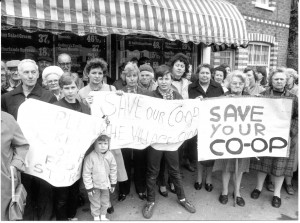
It is good that the new Co-operative shop in Shinfield is involved with the community but there was also a shop in Spencers Wood some years ago. This one was established in 1921, by the Reading Co-operative Society (RCS) whose Headquarters was in Cheapside, in Reading, in premises owned by McIlroys. Primark, in West Street, occupies these premises today. The Co-op in Spencers Wood was very popular and lasted until the mid 1980s when many protesters objected to its’ closure, to no avail. Before this though, the building housed a small confectionary shop run by Miss Horwood whom the local children called ‘Aunt Em’. Miss Horwood surrounded the shop with a large number of Huntley and Palmers biscuit tins and there wasn’t much space for sweets. When the shop closed in the 1920s, RCS updated it making it into a modern grocery store. In the early days, the customers would have been personally served by shop assistants after having queued, until shopping was revolutionised by self service with baskets, trolleys and checkouts.
The building and car park was originally owned by Edwin and Mary Dearlove who ran a nursery and landscape gardening business. They had a large family of nine children, some of which went to Spencers Wood School at our library today, and when Lambs Lane School opened in 1908 they transferred there. William, Thomas and Frederick Dearlove went to school from the tender age of three years. The family was there from early 1900 and left for Reading in 1912 as recorded in the Lambs Lane register. The business transferred to Whitley Street and had nurseries that went through to Kendrick Road.
We know nothing about the building before the Dearloves were there but when the Co-operative left, the building was occupied by Delby’s, the refrigeration company. When they moved to Wootton Grange the building was purchased in 1991, extended and occupied by the Society for General Microbiology (SGM). It was this society that called the building Marlborough House. The Society was first formed in 1945 with the first president being Sir Alexander Fleming. As its’ title suggests, the society professionally studies all aspects of microbiology, giving lectures and writing papers for public interest, nationally and internationally. In 2013, the Society moved to London and is now situated at Charles Darwin House. The premises have been sold and we wonder who or what will arrive next.
Lorna Merry was a founder member of Spencers Wood Women‘s Institute who gave the group these memories to go in our first village book. Initially there were only twenty members but the numbers increased to around sixty or so.
They had lots of speakers from all walks of life and many different topics such as the police, lace making, cake decorating, painting on china, lawyers, dolls of all ages and countries, the Royal National Institute for the Blind, antiques, flower arranging etc. They had some very happy times. A choir was formed which many of them joined under the leadership of Mrs Wellstead. Practices were held at the United Reform Church in the village.
In later years, Mr Jones, who was the organist at St Michael’s church, became the conductor. Other members were Olive Franklin, Nancy Benham, Peggy Gillings, W Runyard, Lorna and many more. They also had a concert party which was great fun. On one occasion they gave a performance as ‘The Black and White Minstrels’ (a popular TV programme , which would be non politically correct today). Supper parties were held and they had many coach trips on which everyone was eager to go. The men folk often came on the trips and they enjoyed them too. On another occasion of the 21st birthday party, the branch held a dinner and social evening. A cartoonist called AREFF printed the cartoon of the committee in the local paper. These are the names in the cartoon; Joan Parkes, Edith Burningham, Peggy Gillings, Miranda Mayne, Eileen Summersgill, Barbara Panting, Mag Dore, Phil Drake, Edna Carter, Eileen Simmons, Janet Rickson, Marjorie Lyon and Lorna Merry.
It was unfortunate that it had to close down in the mid 1980’s because the members were getting older and did not like walking to and from meetings on the dark nights. Lorna and her friend Vera Bowyer were the only surviving original members when they closed. Marjorie Lyon could remember the happy meetings that were held by the WI which were usually educational or instructive. Sometimes members would bring along their personal collections to show and talk about them.
When the group disbanded, each member held a memento from the group and Marjorie had a cup and saucer with WI on them. The idea was that if they group ever reformed the equipment would be in safe keeping until that day. The group has been given the banner of the WI.
Spencers Wood – Farms, Pubs and Stores – An Analysis of the 1881 Census
The 1881 census does not really differentiate between the villages – be it Grazeley, Three Mile Cross, Shinfield Village or Spencers Wood. Our group have spent some time as this data becomes freely available this information, and we have highlighted what we know to have been Spencers Wood.
According to the census, there were 184 individuals living in the area. The majority of those individuals held positions in service to two of the largest houses in Spencers Wood – Stanbury House and Highlands. Both had a butler, 2 housemaids and a kitchen maid. Highlands had their own cook, whereas Stanbury had its own footman! Over 20% of the population of Spencers Wood was “in-service” in one way or another.
In total our village had 56 children and 30 wives. This was the fourth highest number in the census. 19% of the children were classified as “scholars” and an additional 11% were under school age (below five years old). Since there was no compulsory state education until the 1880 Education Act, when school boards were first formed, only four of the wives were in employment and the rest remained at home to look after their children.
The 29 farmers and individuals associated with agriculture (e.g. cowmen) are nearing 16% of the total population. The total farmland (excluding market gardens) was 654 acres or 366 football pitches, with Charles Portsmouth holding 290 acres, with 10 men and 4 boys. Much of that farmland has slowly been built on as Spencers Wood population has grown, and the demand for housing and schools has increased.
Star Inn (opp. Spencers Wood Post Office)
The census lists the Cricketers Inn, (now the Hop Inn), the Star Inn and The Red Lion (opposite the Post Office).Often the pubs were combined with other activities – e.g. Farriers Arms was a blacksmiths originally; Yew Tree Inn was a farm of 20 acres. Over the years, many of these pubs have changed considerably, either being converted to houses or not generating enough business to stay open. Both the Star Inn and the Red Lion have been converted to residential properties. Some, like Yew Tree Inn, owned by a farmer George Arnott of 20 acres, was nicknamed “The Stump” and is now a nursery.
Mr & Mrs Beesley – of Beesley’s Stores
Slowly the village was growing and the small businesses were growing up. There were six in total- One dressmaker, a laundress, a Wheelwright, a Woodman, a Wood Dealer and a General Shopkeeper. Beesley’s Stores stood next door but two to The Farriers Arms in the house now named Tintern and was set up in 1881 by Henry Beesley who came from Littlewick Green, Maidenhead. Beesley’s could well have been the first store in Spencers Wood (picturesand memories of Beesley’s Stores kindly donated by Lorna Merry). Do you know any different?
We are collating information regarding farms, pubs, small trades on our web site – www.swlhg.co.uk. Please email us if you have more information.
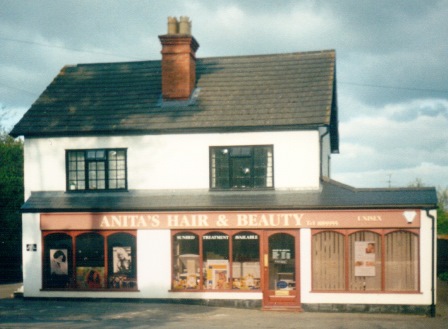
William Clements, aged 28, was recorded as being a baker at Anita’s, in 1891 employing his brother Arthur John Clements. William died in 1902 and Arthur, born in 1873, took over as William left a widow (Emily Cordery) and five children. Arthur also brought his wife, his daughter called Susan, his mother and a sister Rose, from Henley, where Arthur was a journeyman baker.
Arthur and family moved into Glanfield, a house (Upwey) alongside Spring Gardens in Basingstoke Road. From here Arthur also ran a horse drawn bus service between Reading and Swallowfield.
Arthur purchased land originally belonging to Hunter of Beech Hill, near to Back Lane and built two semi-detached houses called Amersham and Bicester after places where he was brought up. One house became the Police House the other Arthur lived in. At the back, he had a grocery shop and built a bakehouse. Eventually he moved to The Limes, (Warings today) where he opened a grocer’s shop. He built a bakehouse at the rear installing the first ovens there. Arthur had seven daughters and the business was called Clements et Filles. He eventually had a son.
The bungalow at the rear of Anita’s was built by Arthur at an unknown date (after 1918) to house his sister Rose, who never married.
The other shop in Anita’s building was occupied by Albert E Webb, who was a saddler and from 1891, ran the business for 50 years. When Edwin Webb retired he built a bungalow called Saddlers on Spencers Wood Hill which has been recently demolished and a new house built.
Behind William’s bakery, at the Summer House was Wilson’s 2d library and sweet shop, which could be Roses Bungalow but more likely to be an extension of the bakery. Herbert Wilson was there from 1935-1960 at least.
Mrs Powell Clements was at the bakery from 1903–1920 and Emily Clements (William’s wife) was there from 1925-1931; Mrs Powell Clements is thought to be the same person as Emily. Edna Carter worked here in the 1960s and in 1966, Rosemary Hairdressers, was here. In the 1970s sometime, it was Michael Charles Hairdressers. For a short while in the 1990’s, it was a Water Bed shop, followed in 1992 by Anita’s. The above is the result of an enquiry about Roses Bungalow made at the Carnival and we wish to thank Ron Holyday again, for his presentation at the Carnival.
The date information has been taken from Directories and is uncertain.
The reverse of the brochure from Anita’s
Margaret BamptonOctober 2014
One of the original brochures from Anita’s
Some of the treatments that you could have received at Anitas
Early on in the 1900s, children didn’t have many outings, but tended to go to local places that were easily accessed. The Library School children went to Grazeley in 1906 as the school treat. The Band of Hope had an outing in 1903 to Oxford when the whole school closed.
According to Rita Goodall who was a teacher from 1985 to 2000 and wrote a piece in our Lambs Lane History, one summer’s day, in 1978, the juniors were invited as part of ‘rent-a-crowd’ to welcome Prince Charles to Wellington Country Park. He visited to open the Dairy Museum. After lining the route, the children were free to wander the Park. One group were speechless when Prince Charles came over to speak to them when he saw them in the woods. Between 1920 and 1939, there were many school outings and the children once went to Bognor, in 1930, by motors which were probably charabancs. In the 1950s, coaches belonging to Smith’s took the children to places like Hayling Island, Southsea, or Brighton and sometimes to London. In 1958, one class went to Portsmouth Dockyard to look over The Victory. Some lucky children were taken to the Palace Theatre in Oxford to watch a ballet.
Ryeish Green School also had outings to London and they were taken to and from Reading Station by wagons and carts where there were two compartments reserved for them by the Great Western Railway. Their exhausting trip took in Charing Cross, Trafalgar Square, Whitehall, Houses of Parliament, Westminster Abbey, Hall and Bridge, Science Museum, Embankment, Colonial Institute, Albert Museum and back to Paddington.
Sunday School Outing at Frensham Ponds
In Our Village of Spencers Wood, Elaine Stobo recalls a Sunday School outing to Frensham Ponds in around 1952, for a picnic. Rev Lewarne was the vicar who accompanied them. There was panic on congregating to return home the only person missing was Rev Lewarne. Nobody knew where he was and one coach load of children returned alone with the younger children on board. Mr Lewarne eventually turned up an hour late. Marion Pyke said that the water was orange, probably from some iron content and that the children’s legs were stained with it. Marion suspects that the public is not allowed into the water these days. Notice from the photo that the girls tucked their dresses into their knickers as they were apt to do in those days!
Margaret Bampton. The above was taken from our history books.




 ch space for sweets. When the shop closed in the 1920s, RCS updated it making it into a modern grocery store. In the early days, the customers would have been personally served by shop assistants after having queued, until shopping was revolutionised by self service with baskets, trolleys and checkouts.