For a good many years the Group has taken responsibility for decorating one of the windows in St. Michael’s Church in Spencers Wood at Christmas.This year the theme is Christmas Carols which brought to mind the book, A Christmas Carol by Charles Dickens…
Many of you will be familiar with this Christmas ghost story which tells how after being haunted by the Ghosts of Christmas Past, Christmas Present and Christmas Yet-to-Come, Scrooge is persuaded to live a better life and to be more generous to the poor, starting with his own employee Bob Cratchit.When Dickens was 12 years old his own father was thrown into debtor’s
prison and Dickens himself was forced to leave school to work in a boot-blacking factory. After this, Dickens took a lifelong interest in the plight of the Poor, campaigning for Children’s Rights, Education and social reform.
In this he was joined by another literary figure, local author Mary Russell Mitford from Three Mile Cross. Both of them were involved with the founding of the imposing Reading Literary, Scientific and Mechanical Institution in London Road, later known as Great Expectations – and now recently renamed, Hotel 1843 Reading. When the Institution was opened, by a formal dinner attended by Mary Russell Mitford, in October 1843, Dickens was too busy to attend: “A Christmas Carol” was published just two months later in December 1843.
Our Christmas window depicts the deep inequality in Victorian society with a generously decorated Christmas tree on one side and on the other a simple “twig-tree” decorated with dried fruit slices. In the middle is a copy of “A Christmas Carol” and more information about Charles Dickens and Mary Russell Mitford.
Right: Patricia, Jackie, Edward and Lesley who created this year’s window
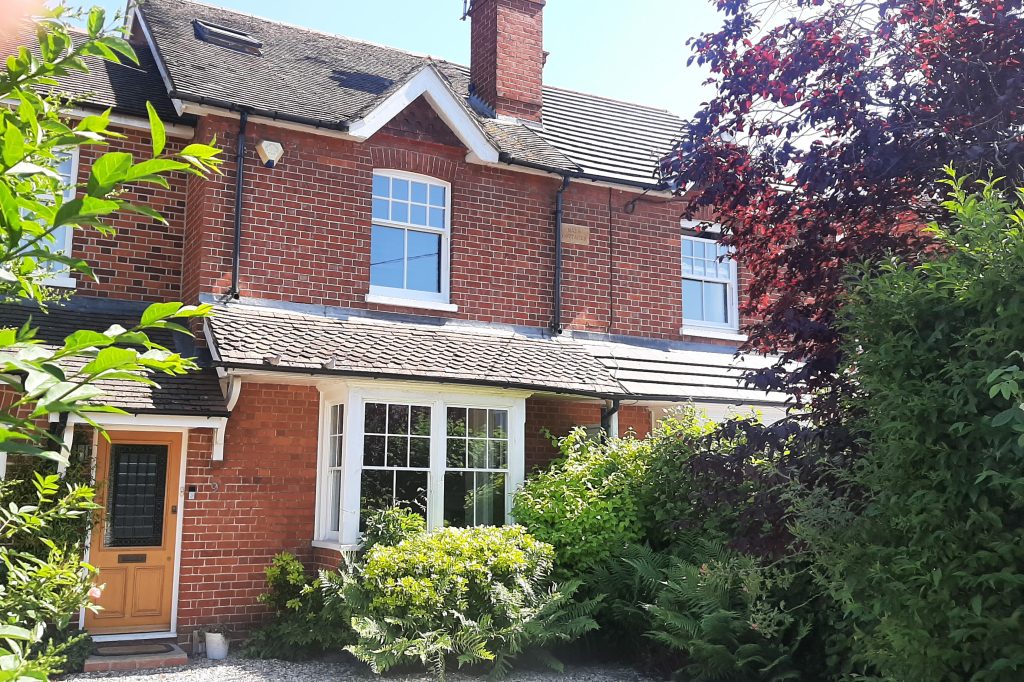
We recently received another enquiry in our mail box, spwood.local history@googlemail.com . It came from someone who had recently moved into the Village and wanted to know more about the history of her new home, May’s Cottages in Beech Hill Road.
The four cottages – two semis – can be found on the left-hand side of Beech Hill Road, more-or-less opposite Clements Close. From the style they were built in the early years of the last century.
We pooled our knowledge at a meeting of the Group – the surname MAY is quite common in Berkshire but to the best of our knowledge hadn’t previously come up in any of the memories we’d collected from older residents of the Village. We also had no information about the houses but one of us recalled that the field at the junction of Yew Tree Lane and Beech Hill Road is marked as May’s Fields on old Ordnance Survey maps. The only other possible connection that we could come up with was Mays Farm in Ryeish Green.
A couple of us set to work and discovered that families by the name of MAY go back to c.1650 in Shinfield. At various times in the C19th and C20th people by this name were living in Spencers Wood and the surrounding district however, most of them were born outside the district and it has not yet been possible to establish whether/how they were related. The three people of greatest interest were
William Henry MAY, born Newbury, 1831 and died Spencers Wood, 1919
George Henry MAY, b. Hungerford, 1859 and d. Arborfield, 1914 and
John MAY, for whom we found a record dating to 1861-62
William Henry MAY was a saddler and for the majority of his life (c.1861-c.1910) lived (and worked) at 10, Gun Street, Reading. He was married twice, to Maria from 1856-1893 and to Fanny in 1901 who survived him. He had retired by 1911, living first in Mortimer West End but by 1918 was living in Oak Tree Lane, Spencers Wood, moving to Wyvenhoe, also in Spencers Wood near St. Michael’s, in 1919.
George Henry MAY is more interesting – both in the sense that he seems to have lived a more eventful life and in relation to his links to May’s Cottages. His early life is uncertain as his place of birth is given variously as Hungerford, Burghfield and Oxenwood but by 1881 he was living in Reading and working as a labourer in a tin factory [presumably Huntley, Boorne, and Stevens who made the tins for Huntley and Palmers]. In 1885 he married Alice Corbett at St.Mary Butts. Whether this prompted a change of direction is uncertain but by 1887 he’s recorded as being a grocer in Tilehurst and in 1891, as living in Katesgrove. By 1901 he’d changed career again and was recorded as a publican at the Sun Inn in
Swallowfield. In the 1911 census he is temporarily unemployed and living in Spencers Wood but two years later he is living at the Shoulder of Mutton in Binfield and when he died in 1914 is recorded as living at Duck’s Nest Farm, Arborfield.
The most interesting information about him is revealed in the Electoral Registers. In 1911 he is recorded as living at 2, May’s Cottages, Spencers Wood, Swallowfield – at this time Basingstoke Road south of the junction with Hyde End Road was in Swallowfield Parish. This was presumably where he was living at the time of the 1911 census. The Electoral Register also reveals that he owned 4 freehold cottages as well as other land. Not all this property was in Spencers Wood as the “qualifying property” is recorded as being at School Green – before the introduction of universal suffrage [for men] in 1919 the right to vote depended on what property you held. Later Electoral Registers show him in Farley Hill (1914).
John MAY
There are a number of people named John May living in the wider Reading area and it is not easy to be certain which is referred to, however there is clear evidence that one such had interests in Shinfield parish during 1860’s. In 1862 William Merry of Highlands House purchased 6 plots of land that allowed him to connect a drive from his house to the Basingstoke Road. He purchased the plots from Lannoy Hunter of Beech Hill House, John Thorpe a farmer and John May. This would imply that John May was a landowner, owning land in Spencers Wood at this time although he need not have been resident. This is supported by the 1861-62 Electoral Register for Shinfield which lists John May of Coburg Villa, London Road, Reading as occupying “freehold land and buildings” in the parish, although the exact location is not specified.
At this time we cannot confidently state that May’s Cottages were named after any of the three above. However since the properties were built in the Edwardian period and George Henry MAY himself occupied no2. in 1911 on the balance of probabilities he would seem to be the most likely. George Henry’s widow, Alice was still living at School Green at the outbreak of War so it is possible that the cottages still remained in her possession at that time.
Mays Hill is named on OS maps on both the first edition OS map of 1871 and the revised edition of 1900 and it is possible that the land belonged to John May who we know held land in the Village round-about that time.
Later occupants of May’s Cottages
In 1939 at the outbreak of World War II, the England and Wales Register shows John Barber and family at 1 Mays Cottages. At no 2 lived Elizabeth Charlton who was still there in 1953 when she died aged 83. The occupants of No 3 are not known but an Elizabeth Cox was at no 4.
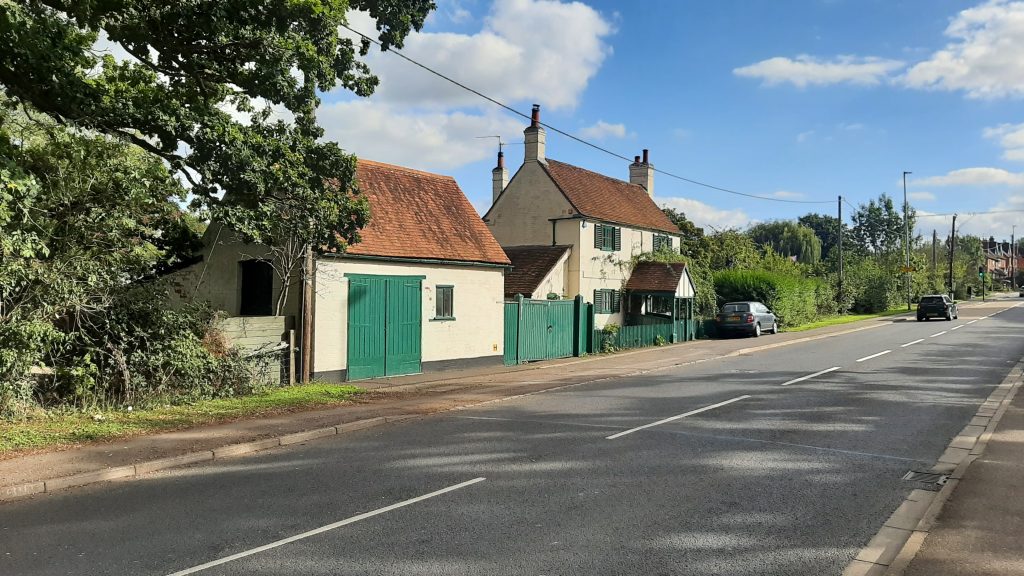
As you walk, or drive, through the Village today it’s not always easy to remember that a hundred years ago Spencers Wood was still primarily an agricultural community. It’s true a growing number of residents commuted to Reading to work – maybe in Huntley and Palmers, Suttons Seeds or Symonds Brewery, the “three Bs” for which Reading was famous – but most residents still worked in agriculture or the local services that supported them. This is not to say that nothing had changed – the growth of Reading and improved transport links to London had resulted in new markets for market gardening and fruit growing and dairying. The evidence for this can still be seen in the street names like Apple Tree Lane and Orchard Close. It was an enquiry from a correspondent in Hampshire which drew our attention to another development, the growth of chicken farming, commemorated in the road name Pursers Gardens.
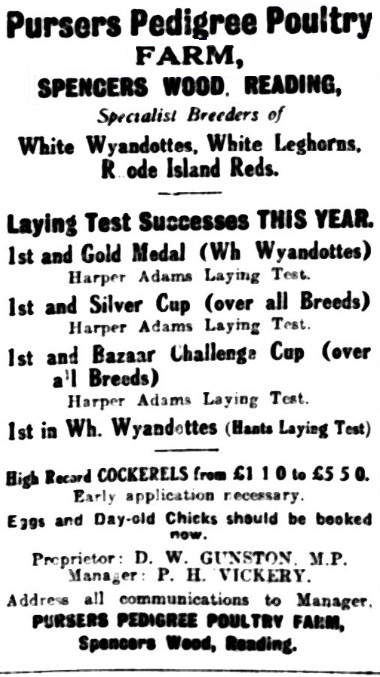
Our correspondent was researching the history of a country house known as “Pursers”, in the parish of West Meon in Hampshire when he discovered links with Pursers Pedigree Poultry Farm in Spencers Wood. Initially registered in Hampshire in the early 1920s, the registered address for the Farm later changed to Spencers Wood. One name associated with both properties was that of D. W. Gunston, M.P. and our correspondent wondered whether we could provide any information about either.
Barry, one of our members, set out to find out more…
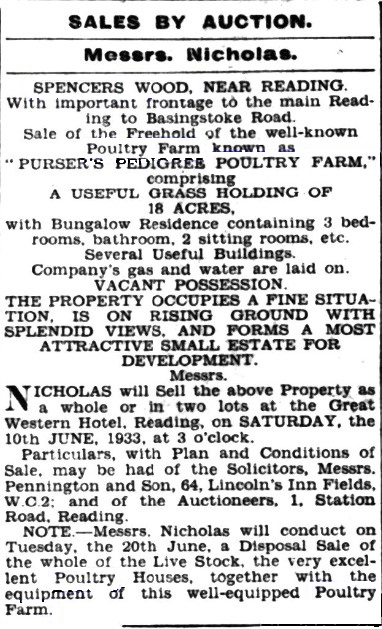
The property was not known as Pursers Farm until 1924. Previously it would appear to have been known as Hill House Farm. In 1924 Hill House Farm was put up for sale. At that time it was already a poultry farm and it was apparently bought by Sir Derrick Wellesley Gunston, who had been farming poultry at Pursers in Hampshire. He bought with him Percy Vickery, who according to the electoral roll had been living at Pursers Lodge, West Meon between 1923 and 1925 as his farm manager, together with Vickery’s wife Florence.
There is a surviving newspaper advert dating to 1925 which suggests that they were successful in breeding prize-winning chickens but by 1933 the Farm was again advertised for sale by auction by Nicholas Estate Agents.
Sir Derrick served in the Irish Guards in World War I and was awarded the Military Cross in 1918. 1n 1924 – the year in which he apparently purchased Hill House Farm – he was elected as MP for Thornbury in Gloucestershire and held the seat until 1945 when he was defeated in the Labour landslide of that year. In 1938 he was created Baronet of Wickwar, also in Gloucestershire. As far as we’ve been able to establish, Percy Vickery and his wife continued to work as poultry farmers and in 1939 are recorded as farming at Kings Farm in Harpsden near Henley with their son, John Henry William Vickery. After the end of World War II they moved to Caversham and Percy died at Battle Hospital in 1961 when his address was given as Wheelers Farm, Swallowfield.
When future generations come to look back on the Coronation weekend there’ll be lots of footage of national events but here is a record of how the Bank Holiday was celebrated in Spencers Wood…
The Local History Group joined other village organisations – along with Morris Dancers and a fairground organ – at the celebration organised jointly by the Village Hall Committee and St. Michael’s Church. Just as well that we were under cover as it rained pretty much the whole time but this didn’t put off the many families that joined in the celebrations and visited our display in St. Michael’s Church, sharing their recollections of their schooldays and local pubs amongst many other memories.
The Group is currently working towards producing a new book, this time about the history of our local pubs. It’s hard to believe but in the past there were as many as 12 pubs and beer houses in Spencers Wood, Three Mile Cross and Great Lee!
If you have family photos or family stories about our local pubs we’d be very interested to hear from you.
With Remembrance Sunday approaching, as part of our series on local road names, it seems the appropriate time to recall those who fell in the Great War 1914-18, who are commemorated in some of the road names in the recently built housing estates.
Mark Horace ALLEN Thomas Henry LAILEY John ALDER William Henry LAILEY Edward Ernest BEALES Henry John PARKER William PIGGOTT Frederick James BOLTON Frederick ALLEN Albert G MAYBANKS Alfred LAWRENCE Jesse James WESTALL Arthur Richard John APPLETON William MEARING Errol Geoffrey ELISHA Austin BAILEY
d. 21-Nov-1914 d. 5-Jan-1915 d. 5-Jan-1915 d. 7-Aug-1915 d. 25-Sept-1915 d. 25-Sept-1915 d. 18-Aug-1916 d. 17-Feb-1917 d. 5-Mar-1917 d. 5-Sept-1917 d. 9-Sept-1917 d. 11-Sept-1917 d. 29-Nov-1917 d. 15-Apr-1918 d. 22-Apr-1918 d. 2-Oct-1918
Allen Way Lailey Path Alder Grove Lailey Path Beales Grove Parker Close Piggott Road Bolton Drive Allen Way Maybanks Lawrence Place Westall Street Appleton Way Mearing Grove Elisha Close Bailey Mews
Almost all the roads are in Shinfield, in the new estate behind the School Green Centre and the Health Centre. The exception is Elisha Close in Spencers Wood. Errol Elisha was a member of the Elisha family about which I’ve written in an earlier post.
Although the above list may seem long, it is by no means a full list of all those from Shinfield Parish who fell in the Great War. All 28 young men who died are commemorated on the War Memorial on School Green, as well as those killed in the Second World War. More information about all of them can also be found on the Roll of Honour website.
A colleague noticed that road names have recently been installed on the roads serving the new Stanbury View estate. On the lefthand side of Basingstoke Road as you climb up the hill from Three Mile Cross, the estate is of course named after Stanbury, the house built on the opposite side of the road for Frederick Alfrey in the 1860s. (You would have to have outstanding eyesight to “view” Stanbury as it was demolished after a fire in the 1960s.)
Left. Lietenant’s Cottage, formerly the Star
The full history of Stanbury and the surrounding estate can be found in our book More from our Village of Spencers Wood, which is still available at the reduced price of £5.00.
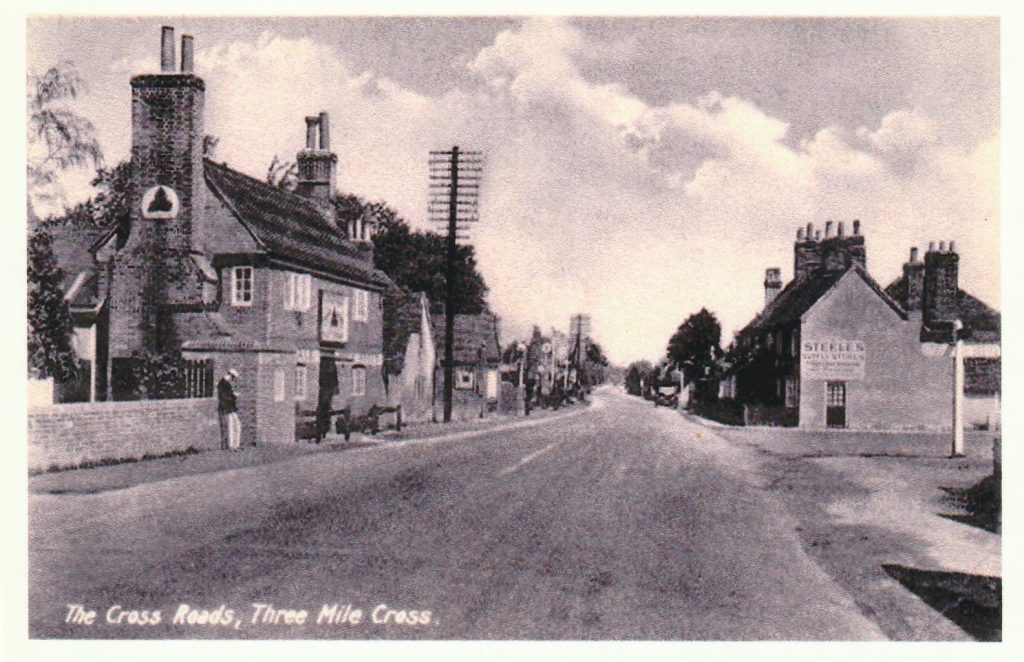
Star Rise, one of the two roads into Stanbury View, commemorates a further episode from local history. Although now better known as the Lieutenant’s Cottage, this was once the Star, described as a beer house – less classy than an inn – run, at the time of the 1851 census, by William and Mary Marlow. At that time, due to its position on the main road to Basingstoke, and beyond that Portsmouth, Three Mile Cross was a regular staging post for coaches and supported a number of pubs. In the same 1851 census, a total of five, including the Star, are recorded: The Fox and Horses, run by Joel and Lucy Brent, The George and Dragon, run by George Banks and his sister Sarah, The Rose and Crown run by George and Mary Strong and the Swan run by William and Mary Barry.
The best known resident of Three Mile Cross at that time was Mary Mitford, the author of Our Village. Mayflower Meadow, the other new road into the estate, is not named after the ship of that name but after one of Mary Mitford’s dogs, Mayflower, or May as she calls her. With Lizzie, her other dog, they were her companions on her many trips around the village.
Right. The George and Dragon one of five pubs in Three Mile Cross in the 1850s.
Over the Bank Holiday Weekend some of our members took part in the Swallowfield Show. It was a busy weekend – it was estimated that more than 900 people visited the Art Exhibition and Local History tent over the two days.
We really enjoyed the opportunity to meet so many people and to share old memories and new information – as well as selling some of our publications. But if you didn’t get to the Show or didn’t manage to visit us and see our displays about Spencers Wood in former days don’t worry! There’s another chance to catch up with us at the Spencers Wood Carnival – held on the Rec. (behind the Farriers Arms) on Saturday, 17th September.
Two long established members of our Group are leaving the Village. Margaret Bampton was one of our founding members back in 1995 and has been a mainstay of the Group and one of the principal contributors to our books and the website over the years. Mary Wheway joined the Group a little later, in 2004. She was formerly a teacher at Ridgeway Primary for 30 years and in her retirement she proved to be just the person needed to lead the editing and publication of all three of our most recent books.
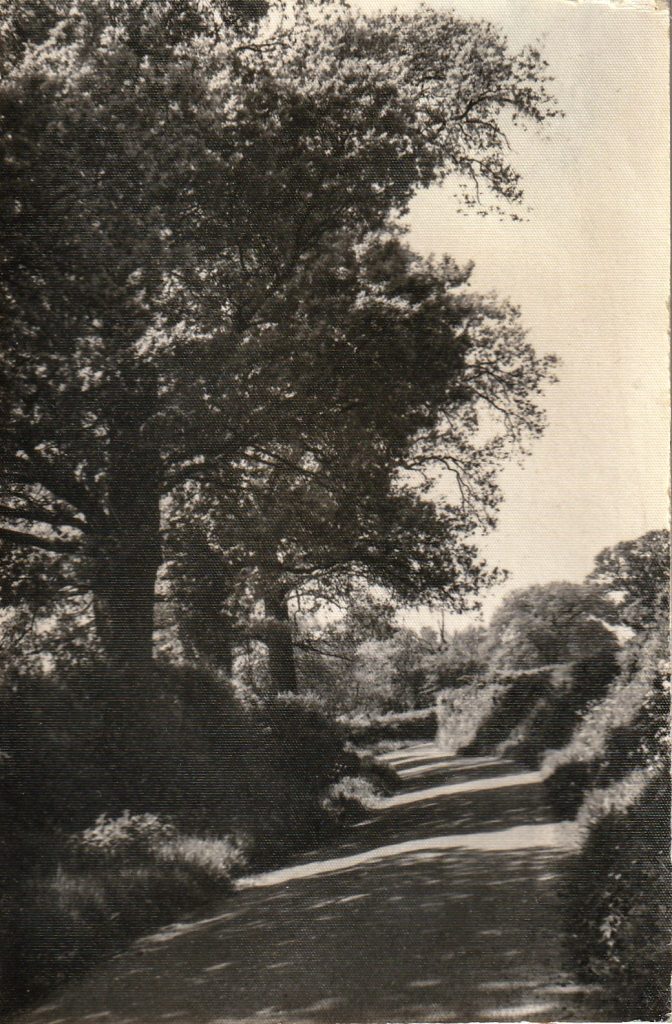
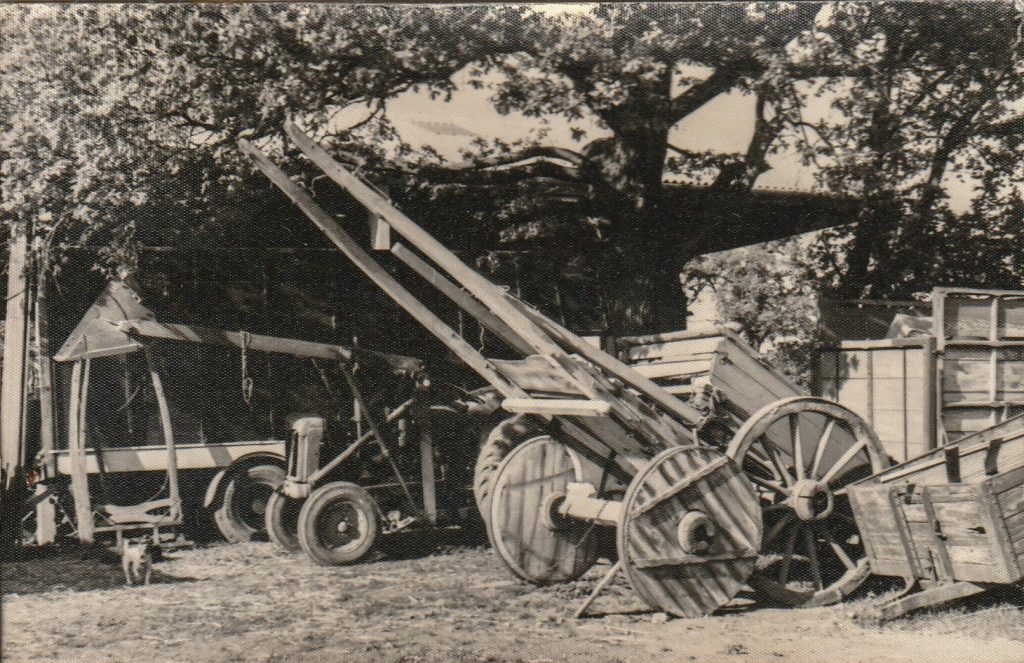
Their departure has resulted in our having to find new homes for the many photographs and other items that have been stored in their respective homes. Amongst these was a collection of photographs taken by Chris Bukin, then aged 8, for a competition organised by Lambs Lane School in 1972, two of which are reproduced here. The full collection can be found in the Resources section of the website.
Margaret and Mary will both be much missed and we wish them all the best for the future.
Group members are involved in work being undertaken by the Parish Council to update their local walks leaflets and two Group members recently took the opportunity to explore what remains of the former RAF flight training base at Shinfield Park. This part of the Parish is now cut off by the M4 motorway and the roundabout-road complex associated with the new University Bridge but in the past it was at the heart of the parish. Until the end of the eighteenth century it was the site
Shinfield Lodge, now The Lodge, where officers were billetted during the War and subsequently the Officers Mess, now a private house again
of the old manor house – when Alexander Cobham purchased the manor, he had it pulled down. Even after this, some of the most exclusive properties in the parish were located on the ridge along the road from Reading and the neighbouring farm, later known as Ducketts Farm, was still known as Manor Farm.
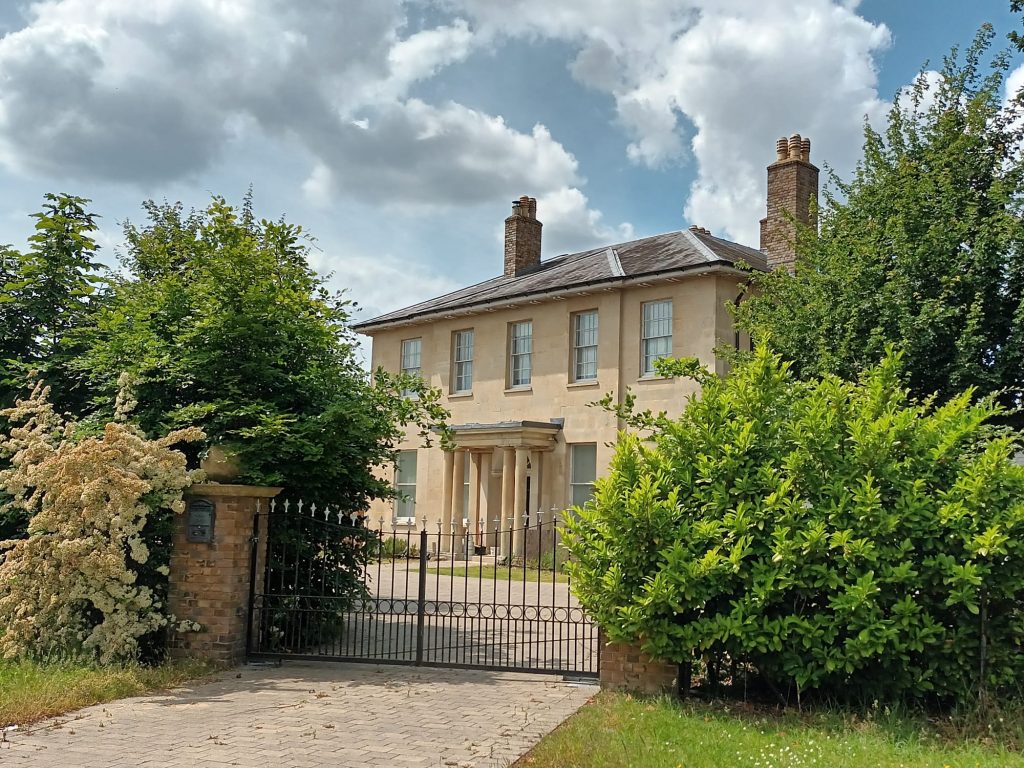
During the Second World War, the Headquarters of RAF Flying Training Command was relocated to Shinfield Park and two of these properties were taken over by the RAF: Shinfield Lodge, a Grade II listed, Georgian building which still survives in the middle of the modern “Met Office” housing estate, and the Grove, which used to stand near the roundabout. After the War, the RAF housing off Whitley Wood Lane was built as accommodation for officers and the Lodge became the Officers’ Mess. A series of pathways leading up the steep, wooded slope linked the RAF housing to the Lodge and other facilities at the top of the rise and the main, partly-gravelled pathway with the remains of two lamp posts marking the route still survive.
RAF Flying Training Command was reabsorbed into Training Command in 1968 and subsequently disbanded in May 1975. After Flying Training Command left Shinfield Park, the Meteorological Office College relocated to the site from Stanmore in Middlesex in October 1971. When the Met. Office HQ relocated from Bracknell to Exeter in 2004, the College relocated at the same time however the European Centre for Medium Range Weather
The wording round the outside reads “To commemorate the site of HQ Flying Training Command RAF Shinfield Park 1940-1968”
Forecasting remained in Shinfield Park. Since then the remainder of the site has been redeveloped for housing. The RAF occupancy was commemorated by the construction of a replica RAF roundel in the verge on AphelionWay. A dedication ceremony was held beside the roundel on 16th January 2013, attended by officers from the RAF, representatives from Shinfield Parish Council and local residents.
In common with other recently-built estates, streets have been named to commemorate the previous history of the area – in the case of the RAF housing, former Commanding Officers of Flight Training Command: Air Marshal Sir Lawrence Pattinson, 1940-1, Air Marshal Sir Philip Babington, 1942-45, Air Marshal Sir Arthur Coningham, 1945-47 and Air Marshal Sir Lawrence Pendred, 1952-55. The other officer commemorated is Sir John Maitland Salmond, who commanded the Training Division during the Great War, going on to become the RFC Commander in the Field on the Western Front and subsequently Chief of Air Staff in 1930. In the case of the Met Office estate, the roads are named after cloud formations, e.g. Cirrus Drive, and meterological situations, eg. Zenith Avenue (the point directly above one’s head) and Aphelion Way (a planet’s furthest point from the sun).
If you are interested it is still possible to follow the footpath from the RAF houses up to Shinfield Lodge. On foot from Three Mile Cross or Ryeish Green you can cross the M4 using the footbridge near the Six Bells pub and then return on the footpath beside the University Roundabout. From the RAF housing you climb through Nores Wood, originally part of the parkland surrounding the Grove which still contains a number of ancient oak trees.
The track from the RAF housing off Whitley Wood Lane to the Lodge still survives passing through Nores Hill Wood.
Alternatively the area is part of the Shinfield Parish footpath walk no. 6. This and other walks leaflets are available from a number of local outlets, including the Parish Office, Spencers Wood Pavillion and Spencers Wood Library.
Sometimes you find unexpected links between projects. In this case, while researching the history of the Royal Oak as part of our project studying the history of the pubs in Shinfield Parish – on which we are working with Shinfield Local History Society – one of our members established that in 1906 the pub was supplied by Dymore Brown’s Royal Albert Brewery in Reading. We had previously encountered the Dymore Brown family as part of our research into the history of Three Mile Cross Methodist Chapel, a project we completed ten years ago.
The Family were committed and enthusiastic Methodists giving generously to a number of local churches including the chapel in Three Mile Cross and Mrs Janet Dymore Brown, wife of the ownwr, laid the foundation stone of the Chapel. The Group’s book, subtitled The Little Village Chapel in the Meadow is still available, price £4.00.
If you know the identity of this group of men, gathered outside the former Red Lion pub or can can help us with our current project on the pubs of Shinfield – photos or stories of those who worked or frequented any of our pubs, many now lost, please get in touch.